The Cost Comparison of Interior Vs. Exterior Drain Tile Systems
For many homeowners, the basement is the “out of sight, out of mind” zone, until the first heavy spring thaw or a summer downpour turns it into an indoor swimming pool. When water begins to seep through the cove joints or trickle down the foundation walls, the priority shifts instantly to protection.However, once you start researching solutions, you are immediately met with a fork in the road: Interior vs. Exterior Drain Tile Systems.
The choice between these two methods involves a complex calculation of cost, convenience, and long-term structural health. This blog provides an exhaustive deep dive into the financial and functional differences to help you decide which investment is right for your home.
Interior Vs. Exterior Drain Tile Systems Knowledge
To choose the right system, you must first understand the fundamental philosophy behind each approach. While both aim to keep your basement dry, they treat the problem from opposite sides of the foundation wall.
The Exterior Modus Operandi: Prevention
Exterior drain tile, often referred to as a “French Drain” at the footer level, is a proactive approach. It involves excavating the soil around your home down to the foundation’s base. A perforated pipe is installed, covered with gravel, and usually paired with a waterproof membrane applied directly to the exterior wall.
The goal is to intercept groundwater before it ever touches your foundation. By keeping the concrete dry, you prevent the freeze-thaw cycles that lead to cracking and the hydrostatic pressure that causes walls to bow.
The Interior Modus Operandi: Management
Interior drain tile is a reactive, or “relief,” system. Rather than stopping water from reaching the wall, it acknowledges that water will eventually find its way under or through the foundation.
Contractors jackhammer the perimeter of your basement floor, install a perforated pipe in a trench, and cover it back up with concrete. This pipe captures water as it enters and directs it toward a sump pump. It is highly effective at keeping the floor dry, but it allows the exterior of the walls to remain in contact with wet soil.
Drain Tile System Cost Comparison in 2026
When it comes to the bottom line, the price gap between these two systems is significant. The disparity isn’t usually due to the cost of the materials; both use similar PVC or flexible piping and gravel, but rather the sheer volume of labor and equipment required.
Breakdown of Average Costs
Expense Factor | Interior System | Exterior System |
|---|---|---|
Price per Linear Foot | $45 – $85 | $100 – $250 |
Standard 150-ft Perimeter | $6,750 – $12,750 | $15,000 – $37,500 |
Sump Pump Installation | Included or ~$1,500 | $1,500 – $2,500 |
Landscape Restoration | Minimal | $3,000 – $10,000+ |
Duration of Project | 2 – 4 Days | 1 – 3 Weeks |
Why the Price Jump?
The primary driver of the exterior system’s high cost is excavation. Moving thousands of pounds of earth requires heavy machinery (backhoes or mini-excavators) and specialized operators. Furthermore, most homes have “obstructions” — decks, patios, air conditioning units, or prize-winning rose bushes, that must be removed and replaced.
Interior systems are labor-intensive in a different way. They require manual labor to haul out buckets of old concrete and dirt through the house and bring in new gravel. However, because this happens within a controlled environment and doesn’t require “moving the earth,” it remains the more affordable option for the average homeowner.
Foundation Drainage Problems
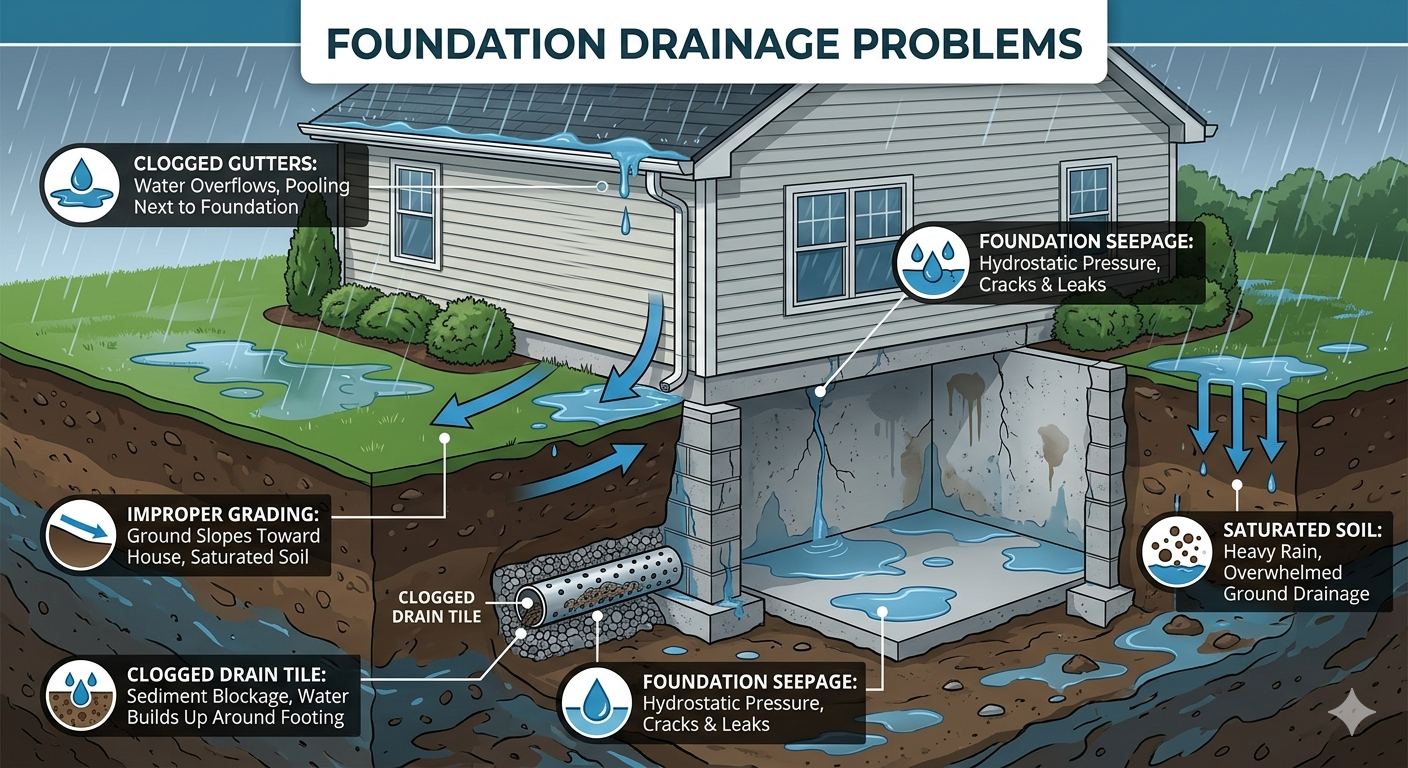
To justify the cost of either system, one must understand the “enemy.” Most basement water issues are caused by hydrostatic pressure. When the soil surrounding your home becomes saturated, it becomes incredibly heavy. This water-logged soil exerts thousands of pounds of pressure against your foundation walls. Concrete is porous; under enough pressure, water will be pushed through microscopic pores, hairline cracks, and the “cove joint” (where the wall meets the floor).
Warning Signs Your Drainage is Failing:
Water Stains: Dark streaks on the bottom of the drywall or concrete.
Musty Odors: A sign that moisture is trapped behind walls, likely fueling mold growth.
Efflorescence: That white, chalky substance on your basement walls. It’s actually salt left behind when water evaporates.
Heaving Floors: If the water pressure under your slab is high enough, it can actually crack and lift the basement floor.
Wall Siding: Horizontal cracks or “stair-step” cracks in brick/block walls indicate the foundation is shifting due to poor drainage.
Repairing Vs. Replacing an Existing System
If your home was built after the 1970s, it likely already has some form of drain tile. If you’re experiencing leaks, you have to decide: can this be saved, or is it time for a total overhaul?
When to Repair?
Sometimes, the system itself is fine, but the “exit” is blocked.
Sump Pump Failure: If your pump is 7 – 10 years old or older, it may simply need replacement.
Clogged Discharge Lines: Roots or debris can clog the pipe that leads water away from the house. A professional “jetting” or snaking can often clear this for a few hundred dollars.
Window Well Issues: Sometimes “basement leaks” are just poorly drained window wells that can be fixed with a simple cover or a dedicated drain.
When to Replace
If your home uses old clay tiles, they have likely collapsed or filled with silt over the decades. Modern systems use perforated plastic pipes wrapped in filter fabric (to prevent silt build-up).
If the system’s bones are crushed or completely sediment-clogged, no amount of snaking will fix the issue. In this case, a full replacement is the only way to guarantee a dry basement.
Hire Trusted Drain Tile System Specialists
Because the stakes are so high, your home’s foundation, this is not the time to hire a “handyman.” You need to hire trusted drain tile system specialists who understand soil mechanics and structural engineering.
Questions to Ask a Contractor:
“Do you provide a lifetime transferable warranty?” This is vital if you ever plan to sell your home.
“How do you manage dust?” Interior drainage involves a lot of concrete cutting. A pro will use HEPA-filtered vacuums and plastic barriers.
“Will you check for structural damage?” If your walls are bowing, a drain tile system alone isn’t enough; you may need carbon fiber straps or steel beams.
“Where does the water go?” Ensure they aren’t just dumping water into your neighbor’s yard, which could lead to legal headaches.
Conclusion
Investing in a drain tile system is rarely a “fun” home improvement, but it is one of the most important for maintaining your home’s value. While the interior system is the champion of cost-effectiveness, the exterior system offers the gold standard in foundation protection. By understanding the costs and the mechanics of each from this blog from Family Dry, you can make a decision that keeps your feet dry and your foundation solid for decades to come.
-
What Is the Difference Between Interior and Exterior Drain Tile Systems?
The difference is the location and the method of protection. Interior systems sit beneath your basement floor and act as a “catch-all” for water that has already reached your home. Exterior systems sit outside the home and act as a “shield,” preventing water from ever touching the foundation walls.
-
Which Drain Tile System Is More Affordable?
Interior drain tile is significantly more affordable. On average, an interior system costs about 50% to 70% less than an exterior system because it avoids the massive costs associated with deep-trench excavation and landscape restoration.
-
Why Is Exterior Drain Tile More Expensive?
Exterior systems require the removal of several feet of earth around the entire perimeter of the house. This requires heavy equipment, more man-hours, and the high cost of restoring the property (replanting grass, rebuilding decks, or repaving walkways) once the pipes are in the ground.
-
How Do I Choose the Right Drainage System for My Home?
Choose Interior if: You have a finished yard you don’t want to destroy, your basement is currently unfinished (making floor access easy), or you are on a strict budget.
Choose Exterior if: You have a finished basement you don’t want to tear up, or if your foundation walls are showing signs of structural “bowing” and need the pressure relieved from the outside.
 About the Author